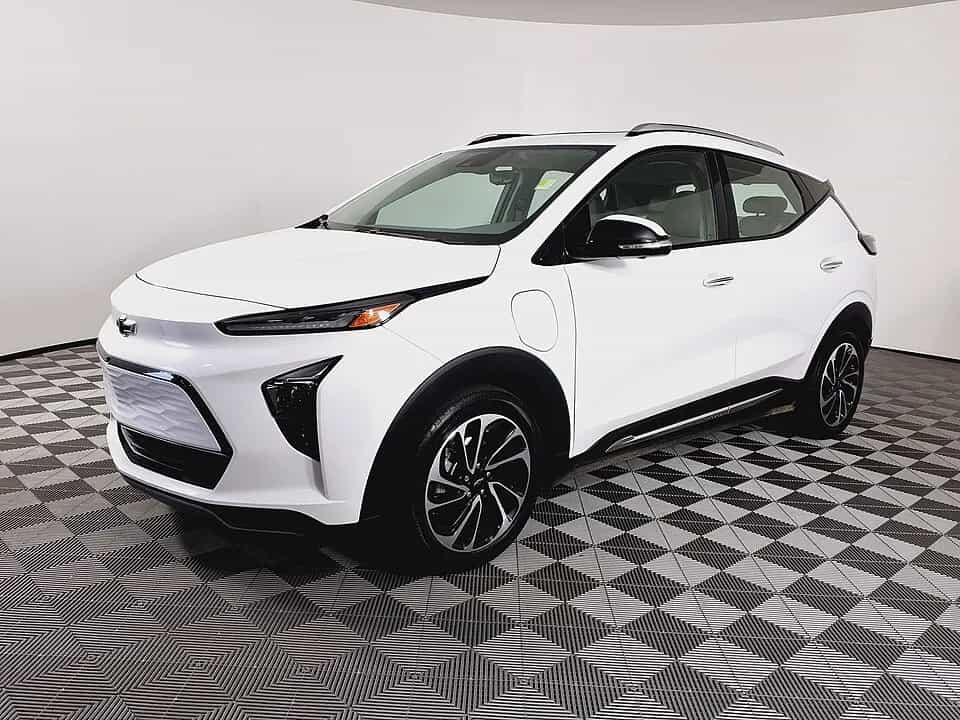
Chevrolet Bolt EUV

Importing a used Chevrolet Bolt EUV from the USA

The Chevrolet Bolt EUV was General Motors' affordable long-range electric crossover, and it was sold in North America but never as an official European model. That makes the US used market the natural place to find one. It is a practical, roomy front-drive EV with a genuine everyday range, and it is one of the few Chevrolets assembled in Michigan — a detail that matters at customs. USCar Trader arranges the whole import as an independent broker: we find the right car, verify its history and battery status, and manage freight, customs and German approval, with no dealer margin.

Chevrolet Bolt EUV – used car imported from the USA
Photo: HJUdall · CC0 · Wikimedia Commons

From launch to today

The Bolt EUV (Electric Utility Vehicle) arrived for the 2022 model year as a slightly larger, more crossover-styled companion to the Bolt EV hatchback. Its production run was short: 2022 and 2023 only, before GM paused the Orion Assembly line to retool for the next Ultium-based generation. Because the run was brief, most cars on the US market are recent, low-to-moderate mileage examples still carrying much of their original warranty history.

Engines and drivetrain in detail

The Bolt EUV uses a single front-mounted electric motor producing around 200 hp (150 kW) and about 360 Nm of torque, drawing from a 65 kWh lithium-ion battery. Drive is to the front wheels only — there was no all-wheel-drive Bolt. EPA range is rated at roughly 247 miles (about 397 km). DC fast charging peaks near 55 kW, which is modest by newer standards, while Level 2 AC charging suits overnight home use. One-pedal driving and the Regen on Demand paddle are standard, and higher trims offered GM's hands-free Super Cruise on compatible highways.

Trim levels and variants

The Bolt EUV came as a five-door, five-seat crossover in LT and the better-equipped Premier trim. Options included a panoramic sunroof, leather, adaptive cruise, and Super Cruise. It is closely related to the Bolt EV but rides on a longer wheelbase, giving noticeably better rear legroom — the main reason buyers choose the EUV over the EV.

Used availability in the USA

Supply is concentrated in the 2022 and 2023 model years. Many cars benefit from the extensive GM battery service campaign carried out during the recall period, which for a used buyer can be a positive — a large share of high-voltage batteries were replaced or software-remediated. Typical examples show low to moderate mileage, and California and Sun Belt cars are common and rust-free. Always confirm the battery's recall and replacement status in the vehicle records.

When importing makes sense

The Bolt EUV suits a buyer who wants an affordable, spacious, easy-to-live-with electric crossover and does not need all-wheel drive or ultra-fast charging. If you value real interior space, a proven GM battery and a car that stands out from the usual European EVs, importing a used Chevrolet Bolt EUV from the USA is a sensible route to one.

Facts and figures

Body style5-door electric crossover
US model years2022–2023
MotorSingle front, ~200 hp (150 kW)
Torqueapprox. 360 Nm
Battery65 kWh lithium-ion
EPA rangeapprox. 247 mi (~397 km)
DC fast chargeup to ~55 kW
AC chargingup to ~11 kW (Level 2)
DriveFront-wheel drive
0–100 km/hroughly 7.0 s
Lengthapprox. 4.31 m
Wheelbaseapprox. 2.68 m
Seats5
Charge portCCS1 (US standard)
Build countryUSA (Orion Assembly, Michigan)

Reliability and common problems

The Bolt platform's headline issue was the high-voltage battery recall affecting certain LG-supplied cells, which GM addressed through replacements and battery management software updates. For a used buyer this is now largely a documentation question: confirm the campaign was completed. Beyond that, Bolt EUV common problems are minor — occasional infotainment glitches, 12-volt battery drain if the car sits, and the usual EV tyre wear from instant torque. The single-motor drivetrain is mechanically simple and Bolt EUV reliability is generally strong once the battery status is verified.

How US versions differ

The most important difference is charging: US cars use the CCS1 (Combo 1) DC port and a J1772 AC inlet, whereas Europe uses CCS2 and Type 2. You will need adapters or an inlet solution for European public and home charging — plan for this before import. US cars also run mph clusters, amber markers and US-aimed headlights, and typically lack a rear fog lamp. The telematics (OnStar) module is configured for North America.

From US purchase to registration

Selection of the right Bolt EUV, then a VIN and origin check, a secure escrow payment, US inland transport and ocean freight to Europe, customs clearance, the TÜV individual approval (Einzelabnahme) including the electric-vehicle checks, and German registration.

Costs, duty and taxes at a glance

Bottom line: what matters is the factory shown by the VIN – proven US origin unlocks 0% duty. The 19% import VAT always applies.

The two charges are separate. Import duty depends on the actual build plant: the 0% EU rate under Regulations (EU) 2026/1455 and 2026/1461 applies only with provable US origin, verified via the VIN and plant. The Bolt EUV was assembled at Orion Assembly in Michigan, which can support US origin — but this must be proven from the VIN in each case; we never treat it as automatic or guaranteed. The 19% German import VAT (Einfuhrumsatzsteuer) always applies on top, calculated on customs value plus any duty and freight. There is no hidden margin.

TÜV, approval and license plates

Typical work: headlight conversion, fitting a rear fog lamp, verifying the odometer, confirming the charging solution for CCS2/Type 2, and presenting the US title. EV-specific documentation on battery capacity and safety is checked at the Einzelabnahme.

Pre-purchase checklist

Match the VIN to the title; obtain a full Carfax or AutoCheck report; confirm the battery recall/replacement status in writing; verify a clean, non-salvage title; check the 12-volt battery and infotainment; review charging history and cable/adapter inclusion; and inspect tyres for uneven wear.

Import FAQ

Can I import a used Chevrolet Bolt EUV from the USA?

Yes. USCar Trader handles sourcing, freight, customs and TÜV, including the EV-specific approval steps.

Does the Bolt EUV qualify for 0% import duty?

It was built in Michigan, which can support US origin, but the 0% rate applies only when origin is proven from the VIN — never automatically.

What is the real-world range?

The EPA rating is about 247 miles (~397 km); real-world figures depend on speed, climate and load.

Will it charge in Europe?

The car uses CCS1/J1772, so you need an adapter or inlet solution for CCS2/Type 2 infrastructure.

Is the battery recall a problem?

Not if it was completed — many cars received new batteries or software fixes; always confirm the status.

Do I always pay German import VAT?

Yes, 19% Einfuhrumsatzsteuer always applies, separate from any customs duty.

Is the Bolt EUV all-wheel drive?

No, it is front-wheel drive only.

How reliable is the Bolt EUV?

Generally strong once battery status is verified; only minor electronic niggles are common.

See more Chevrolet in the Carhub, compare the related Chevrolet Bolt EV and the larger Chevrolet Equinox EV, or browse current Bolt EUV listings.